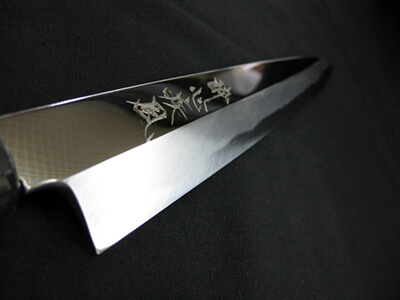
That Moment You Know the Edge Is Right – Honba-zuke for Long-Lasting Sharpness
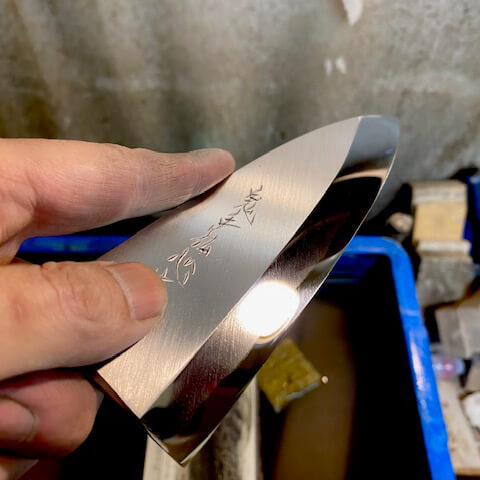
For today’s custom order from Suisin’s Dream Workshop, I performed Honba-zuke on a Blue Steel No.2 knife.
The customer’s request was clear:
“I would like an edge that stays sharp for a long time.”
Whenever I receive a request like this, the first thing I do is study the knife itself.
Rather than immediately putting it to the stone, I carefully examine how it has already been sharpened.
Sharpening without understanding the knife often leads to irreversible mistakes.
Because these knives are handmade, no two are ever exactly the same.
My job is to bring each one as close to perfection as possible.
This knife was originally forged with a very thin blade.
If the owner simply sharpened the edge lightly after purchasing it, the cutting performance would probably be outstanding.
However, this order required something different.
The goal was long-lasting edge retention.
To achieve that, I needed to leave the blade slightly thicker overall while forming a Hamaguri edge with a thin cutting edge.
As I worked, I gradually corrected the uneven areas of the blade road while carefully reshaping the geometry.
The quickest method would be to grind away the entire thin blade at once.
But doing so would make the knife noticeably narrower.
Instead, I prefer to reshape it gradually.
It feels like compressing several weeks of careful sharpening by a professional chef into just two or three hours.
From there, I patiently refined both the blade road and the cutting edge.
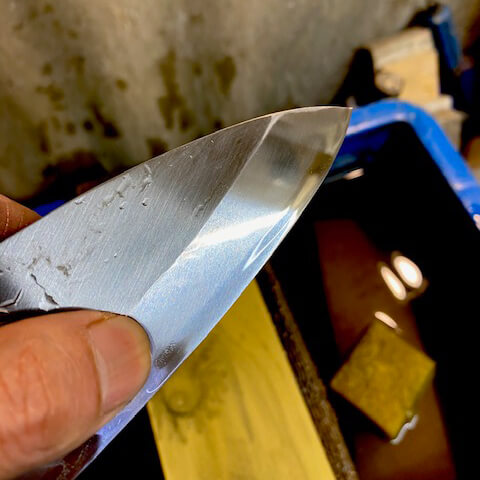
The soft iron was given a beautiful kasumi finish with the medium stone, while the steel was polished using the finishing stone.
Bringing out the shine only on the steel is surprisingly difficult.
If the angle is even slightly off, the soft iron begins to shine as well.
So I work slowly and carefully, always hoping,
“May this knife cut beautifully.”
Finally, I added an Itohiki edge to complete the sharpening.
As a final test, I sliced through a sheet of newspaper.
It felt excellent.
Tomorrow, after letting the knife rest for a day, I will test it again.
Sometimes, after sharpening continuously for hours, your own senses become a little dull.
The best feeling is when you pick up the knife the next day and think,
“Can this knife really be made any sharper than this?”
If I feel that tomorrow, I will know the sharpening was a success.
I’m already looking forward to it.
Daily Practice
December 13, 2006